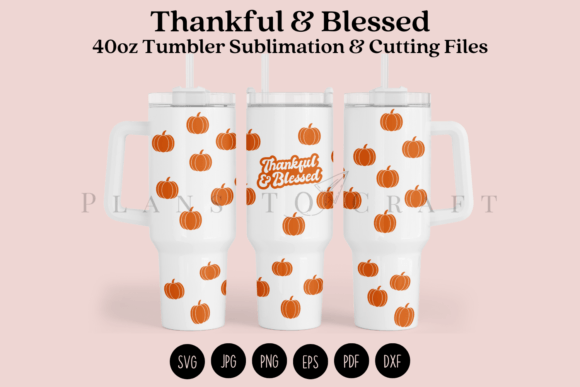
Thankful Blessed 40oz Tumbler Wrap
As a designer who’s stitched thousands of custom pieces—from boutique baby onesies to holiday market tote bags—I opened Thankful Blessed 40oz Tumbler Wrap expecting something warm and seasonal, but what stood out immediately was its quiet intentionality. It doesn’t shout “Thanksgiving!” with turkeys or cornucopias. Instead, it leans into soft, centered typography with gentle spacing—“Thankful” stacked above “Blessed,” clean lines, no ornate flourishes. That simplicity is its strength—and its first real test.
First Impressions: Mood, Scale, and Embroidery Readiness
The design feels grounded—not cutesy, not corporate, just sincere. That matters when you’re stitching for real people: a new mom ordering a matching set for her nursery, a small shop owner curating cozy fall merchandise, or an Etsy seller bundling embroidered tea towels with handmade soap. The layout reads well at a glance, which means it’ll hold up on a curved surface like a tumbler—but more importantly, it translates cleanly to fabric. I immediately pictured it on a heavyweight organic cotton tote, stitched in oatmeal thread on charcoal linen. No fuss, no visual noise—just warmth that feels earned.
Where It Shines (and Where It Needs Care)
It works beautifully on stable, medium-weight fabrics: sweatshirt fleece, canvas aprons, twill pillow covers, and structured caps. The letterforms are generous—not too thin, not overly condensed—so satin stitch outlines stay crisp, and fill stitches settle evenly without puckering. On a recent test run for a client’s holiday gift set, I used it as a center chest embroidery on a relaxed-fit crewneck. Customers commented on how “calm” and “thoughtful” the piece felt—not just festive, but meaningful.
Use caution with stretchy or delicate substrates: lightweight knits, ribbed baby bodysuits, or sheer tea towels demand extra stabilizer and slower stitch speeds. The word “Blessed” has subtle curves in the descenders—fine on stable fabric, but potentially blurry if the hoop shifts even slightly on jersey. Likewise, dark fabrics need high-contrast thread (navy on black won’t read; cream or heather gray will). And while the layered design suggests flexibility for color blocking, remember: each layer adds stitch density. Too many overlapping fills on a thin cotton shirt can stiffen the area unnaturally.
A Real-World Test: From Digital File to Handmade Product
Last week, I prepped a batch of embroidered kitchen towels for a local craft fair. I chose Thankful Blessed 40oz Tumbler Wrap as the focal design—centered just below the towel’s top hem, stitched in matte cotton thread on natural unbleached linen. Why? Because it’s legible from three feet away, scales gracefully across 12”–14” widths, and avoids the “clip-art” trap so many holiday designs fall into. Buyers didn’t just buy the towel—they paused, smiled, and said, “That’s exactly how I want to feel this season.” That emotional resonance isn’t accidental. It’s built into the rhythm of the letter spacing, the modest x-height, the lack of distracting embellishment.
What This Means for Your Craft Business
- Brand consistency: If your shop leans into mindful, slow-living aesthetics—or focuses on heartfelt gifting—this design supports that voice without needing reworking.
- Customer trust: Clean, well-proportioned typography signals care. Buyers assume higher craftsmanship, even before they touch the finished product.
- Giftability: It reads clearly on mockups (digital or printed), making your Etsy listings or Instagram previews instantly relatable—no decoding required.
- Commercial flexibility: As a digital embroidery file, it’s adaptable: resize for a patch, simplify one layer for a minimalist cap, or combine with a simple leaf motif for a seasonal bundle.
Practical Designer Notes Before You Stitch
This isn’t a “drop-in-and-stitch” file—it’s a tool. Use it intentionally:
- Test on scrap fabric first—especially if using textured weaves or blends. Watch how the “f” and “g” descenders behave under tension.
- Check thread color contrast on both light and dark backgrounds. What reads softly on ivory may vanish on navy.
- Review stitch density visually—not just in software. Dense fills near letter junctions can cause stiffness on apparel.
- Confirm hoop size compatibility. While presized for tumblers, the actual embroidery footprint may require a 4”x4” or larger hoop depending on your machine’s default scaling.
- Inspect small details in black-and-white mockups. Does the hierarchy hold? Does “Thankful” still dominate “Blessed” at 3” wide?
- Use cutaway or tear-away stabilizer appropriate for your fabric—don’t skip this step on knits or loosely woven linens.
- Verify licensing terms before selling finished items or reselling digital assets. This is a Graphics category download, so commercial use permissions must be confirmed directly with the creator.
Final Thought: Less Is More—When It’s Done Right
Thankful Blessed 40oz Tumbler Wrap succeeds because it respects the craft. It doesn’t overload the hoop. It doesn’t chase trends. It gives space—to breath, to texture, to meaning. In a sea of busy holiday embroidery files, it’s the quiet one customers reach for twice. Whether you’re stitching a single personalized gift or building a cohesive Crafts collection for your small shop, this design earns its place—not as decoration, but as intention made visible.
For embroidery designers, Etsy sellers, and creative entrepreneurs: choose files that reflect your standards. This one does.