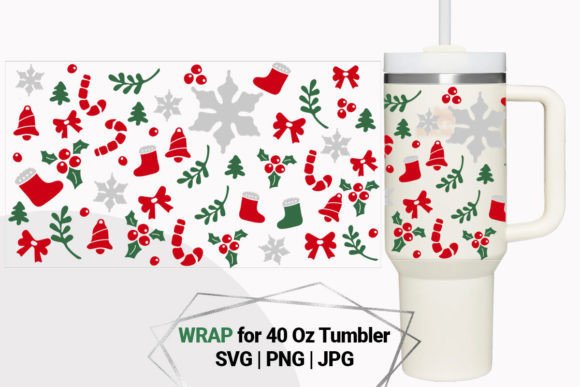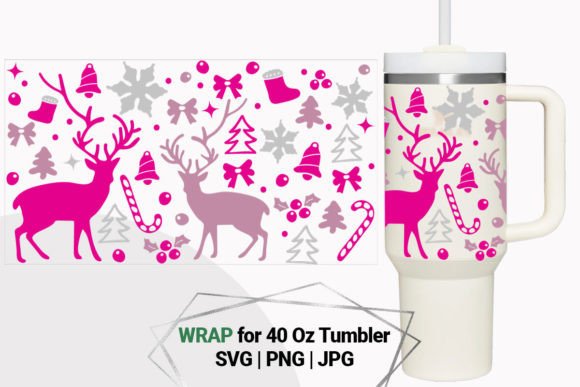
Pink Christmas Wrap for 40 Oz Tumbler
First Impressions: Festive, Feminine, and Purpose-Built
When I opened the Pink Christmas Wrap for 40 Oz Tumbler files, what struck me wasn’t just the color—it was the intention. This isn’t a generic holiday swirl or a cluttered wreath; it’s a clean, vertical wrap design that wraps *around* the visual idea of a tumbler—curved layout cues built right into the composition. The soft pink palette feels modern and inclusive, avoiding overly saccharine or dated tropes. There’s subtle texture in the ribbon folds, gentle scalloping on the bow edges, and balanced negative space—details that translate well to embroidery without demanding ultra-fine digitizing. As a designer who’s stitched hundreds of holiday motifs, I immediately saw this working on a blush linen tea towel, a heather-pink baby sweatshirt, or even as an embroidered patch on a denim apron.
A Real Project Test: Stitching It on a Holiday Tote Bag
Last week, I prepped a custom order for a local boutique: five limited-edition canvas tote bags, each with a hand-embroidered holiday motif. I chose Pink Christmas Wrap for 40 Oz Tumbler—not because it was “for tumblers,” but because its vertical rhythm and moderate width (roughly 3.5–4 inches tall) fit perfectly centered on the tote’s front panel. I used medium-weight cutaway stabilizer and 40-weight poly thread in rose quartz and ivory. The satin stitch on the ribbon held beautifully; the fill stitch in the bow didn’t pill or shadow through the canvas. Customers responded instantly—several asked if it came in other colors, and one reordered two more bags as gifts. That kind of organic engagement tells me this design reads clearly at arm’s length, carries warmth without cliché, and supports the handmade product story—not competes with it.
Where It Shines (and Where to Pause)
Pink Christmas Wrap for 40 Oz Tumbler excels on stable, medium-weight fabrics: cotton twill for aprons, French terry for sweatshirts, brushed poly-cotton for pillow covers, and even light canvas for patches. Its moderate detail level makes it forgiving on textured surfaces—no micro-stitching that disappears in terry loops or fleece pile. On baby embroidery? Yes—especially on knit onesies, as long as you use lightweight tear-away and reduce density slightly. For custom apparel like crewnecks or joggers, it anchors nicely above the pocket or centered on the chest.
Use caution on highly stretchy knits (like ribbed cuffs or curved cap fronts) unless you’re confident adjusting underlay and pull compensation. Tiny corners—like where the ribbon ends tuck—can blur on thin fabrics like voile or lightweight chambray; test those areas first. And while the pink reads beautifully on cream, oat, or light gray, avoid placing it directly over dark charcoal or navy without adding a white underlay layer in your embroidery software—it’ll mute contrast and lose definition.
Design Integrity Meets Commercial Practicality
This isn’t just a pretty graphic—it functions as reliable design assets for craft business owners. As an Etsy seller myself, I know how much weight a single cohesive motif carries across listings: one design, multiple mockups (tote bag, mug sleeve, tea towel), consistent branding, faster turnaround. Pink Christmas Wrap for 40 Oz Tumbler scales cleanly from 3-inch hoop work to larger 5×7 placements, and its SVG/PNG/EPS/JPEG flexibility means I can prep printable mockups for social posts *and* feed clean vectors into my embroidery digitizing software. That dual-use value is rare—and critical when you’re juggling client deadlines, craft fair prep, and digital product launches.
Visually, it lifts perceived value. A plain pink tumbler becomes a curated holiday gift. A basic kitchen towel gains personality without looking busy. That quiet professionalism builds customer trust—people don’t buy “a pink thing,” they buy a thoughtfully composed, seasonally resonant detail that says “this was made with care.”
What Every Embroidery Designer Should Check Before Stitching
- Test on scrap fabric first—especially if stitching on textured or dark material.
- Review stitch density—if your machine struggles with dense fills, reduce density by 5–10% before final run.
- Confirm hoop size compatibility—the design fits comfortably in a 4×4 hoop, but verify exact dimensions in your software before loading.
- Inspect small details—zoom in on bow loops and ribbon ends; make sure no elements are thinner than 0.8mm in your vector file.
- Try black-and-white mockups—to assess contrast and legibility without color bias.
- Compare light vs. dark fabric backgrounds—some pink tones recede on warm beiges; adjust thread hue if needed.
- Use appropriate stabilizer—cutaway for knits, tear-away for stable wovens, no-show mesh for sheer layers.
- Verify licensing terms—since Pink Christmas Wrap for 40 Oz Tumbler is listed as Graphics in the Crafts category, confirm whether commercial use of finished embroidered items or resale of digital files is permitted.
Final Thought: A Quiet Workhorse, Not a Flashy Gimmick
Pink Christmas Wrap for 40 Oz Tumbler won’t shout—but it doesn’t need to. It’s the kind of embroidery file that earns repeat orders, gets tagged in customer photos, and holds up across seasons because it’s festive without being time-bound. It respects the craft: no impossible angles, no thread-trap corners, no over-engineered flourishes. Whether you’re stitching holiday gifts for neighbors, building a small shop product line, or sourcing design assets for client-branded merchandise, this one lands with quiet confidence. Just remember—great embroidery starts not with the flashiest file, but with the one that stitches true, reads clear, and feels like it belongs.