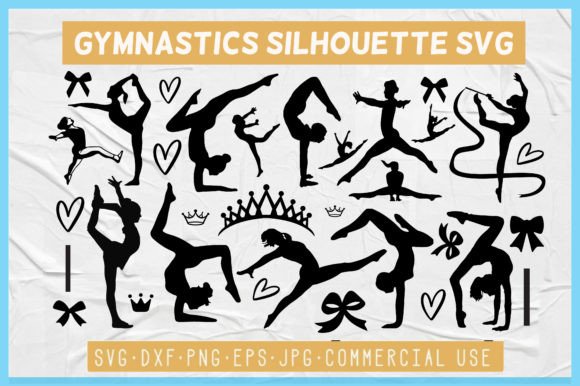
Gymnastics Silhouette SVG, Gymnast SVG
A Clean, Confident Shape — Not Just Another Clipart Cutout
First impression? This isn’t a busy, over-rendered gymnast mid-flip with exaggerated limbs and cartoonish flair. Gymnastics Silhouette SVG, Gymnast SVG is distilled: one strong, balanced pose — arms extended, leg lifted, torso grounded — rendered in pure silhouette. It feels athletic but serene, precise but graceful. There’s no facial detail, no costume texture, no shadow play — just clean negative space and confident contour. That simplicity is its biggest strength for embroidery: it translates directly into stitch without visual noise or unnecessary complexity.
What It Actually Embroiders Well (and Where It Shines)
I recently used Gymnastics Silhouette SVG, Gymnast SVG on a custom cotton tote bag for a local gymnastics studio’s end-of-season gift. We chose a medium-density fill stitch with satin-stitched outer edge — and it held up beautifully. The clean lines meant no jagged edges, no “fuzzy” corners where the machine struggled. On that smooth, tightly woven fabric, the shape read instantly at 3.5 inches tall — clear, recognizable, and professional.
It works especially well for:
- Sweatshirt embroidery — placed subtly on the left chest or back yoke, it reads as thoughtful branding, not juvenile decoration;
- Embroidered patches — the silhouette holds crispness when cut and sewn onto jackets or backpacks;
- Baby embroidery — stitched onto a soft cotton onesie or burp cloth, it avoids cutesy clichés while still honoring the sport;
- Nursery decor — framed as a stitched hoop art piece or on a pillow cover, it adds quiet, intentional personality;
- Etsy listings and boutique merchandise — as part of a curated collection of sports-themed design assets, it stands out for its restraint and maturity.
Where to Pause — Real Fabric & Stitching Realities
This isn’t a design that forgives poor execution. Its elegance depends on precision — so here’s where I slow down before stitching:
- Hoop size matters: At under 4 inches wide, it fits standard hoops, but avoid pushing below 3 inches — small details like the curve of the lifted knee or the space between arm and torso can blur if scaled too tight.
- Fabric texture is your co-designer: On terry cloth towels or heavily brushed fleece, the silhouette loses definition. Stick to stable, low-pile fabrics like cotton poplin, twill, or midweight denim for best clarity.
- Stretchy or thin fabrics need extra care: Use cutaway stabilizer underneath — not just tear-away — especially for baby bodysuits or lightweight tees. Without it, the shape can pucker or distort around the outer curve.
- Dark fabric demands contrast testing: That clean silhouette disappears on navy or charcoal unless you use bright white, neon yellow, or metallic thread. Always test thread color on scrap first — don’t assume black-on-black will read.
- Caps and curved surfaces require repositioning: The shape doesn’t naturally wrap — it’s flat and frontal. For front-panel cap embroidery, center it carefully and confirm your machine’s cap frame accommodates the width without distortion.
How It Elevates the Finished Product — Beyond Just “Stitching It”
When customers see this on a handmade product — say, a personalized sweatshirt for a gymnast’s birthday — they don’t just register “a girl doing gymnastics.” They sense intention. The minimalism says “this was chosen, not grabbed.” That builds trust. It tells them the maker understood the athlete’s discipline, not just the sport’s aesthetics.
In my craft business, using Gymnastics Silhouette SVG, Gymnast SVG on holiday tea towels or embroidered kitchen aprons added quiet sophistication — no glitter, no slogans, just confident form. Buyers responded by asking for matching sets, not single items. That’s value beyond the stitch count: it supports brand consistency across products and invites repeat engagement.
For Etsy sellers, it’s a versatile digital embroidery file that pairs easily with monograms, names, or simple date stamps — making personalization feel cohesive, not slapped-on. And because it’s offered in multiple formats (SVG, EPS, DXF, PNG with transparent background), it adapts whether you’re prepping for machine embroidery, vinyl cutting, or printable mockups.
Practical Designer Notes — Before You Load the Hoop
Before committing to a client project or bulk production, I always:
- Run a test on scrap fabric — same type, same stabilizer, same thread colors;
- Check stitch density visually: too dense and it’ll feel stiff on baby items; too sparse and the shape won’t hold on textured towels;
- Review all corners and curves in the embroidery software — does the satin stitch flow smoothly along the arch of the back? Does the fill lock cleanly at the foot?
- Preview in black-and-white mockups — helps spot unintended optical weight or imbalance;
- Compare how it reads on light vs. dark backgrounds — crucial for product photos and listing thumbnails;
- Confirm licensing terms before selling finished embroidered items or bundling the file for resale — since it’s categorized under Graphics, not pre-cleared commercial embroidery designs, due diligence is non-negotiable;
- Remember: even a perfect Gymnastics Silhouette SVG, Gymnast SVG won’t compensate for weak stabilizer choice or mismatched needle/fabric combo.
Final Thought: A Design That Earns Its Place
This isn’t a trend-chasing graphic. Gymnastics Silhouette SVG, Gymnast SVG earns its place in a serious craft business because it balances recognition with restraint, versatility with integrity. It works for a toddler’s onesie and a studio owner’s custom apron. It reads clearly on a 2-inch patch and holds presence on a 6-inch pillow cover. In the world of Crafts and Graphics, that kind of quiet reliability is rare — and worth every stitch.