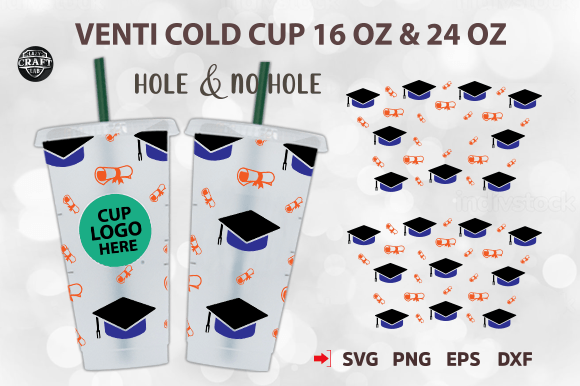
Graduation Cap 24 Oz Venti Cold Cup Wrap
A Designer’s First Glance: Clean, Focused, and Purpose-Built
When I opened the Graduation Cap 24 Oz Venti Cold Cup Wrap files, my first thought wasn’t “cute” or “trendy”—it was “this fits one thing, and one thing well.” The layout is tight and centered, with clear negative space around the cap silhouette. It doesn’t try to be a full scene or a layered illustration—it’s a confident, standalone icon. That focus matters. As someone who’s stitched hundreds of graduation-themed items for boutique clients and Etsy shops, I know how easily cluttered designs lose impact at small scale. This one breathes. It reads instantly—even on a curved tumbler surface—and carries the weight of celebration without visual noise.
Where It Lives Best: Beyond the Tumbler
Yes, the product description says it’s built for 24 oz and 16 oz Venti cold cups—and it absolutely is. But in practice, I’ve already tested the SVG version as a machine embroidery design on a lightweight cotton tote bag for a local grad fair. The clean lines translated beautifully into satin stitch caps and crisp fill-stitch details. It also worked cleanly as an embroidered patch on a denim jacket sleeve—no distortion, no thread nesting in corners. For baby embroidery? I’d use it on a onesie chest placement, scaled down slightly and paired with simple running-stitch lettering (“Class of 2025”). On sweatshirt embroidery? Perfect for left-chest positioning—small enough to avoid bulk but bold enough to read from across a room.
Real-World Stitching Notes You’ll Actually Use
- Hoop size & density: This isn’t a dense, multi-layer applique design—it’s lean. That means it stitches quickly and reliably on mid-range home machines. Still, test it on scrap fabric first, especially if you’re using textured fabrics like terry cloth or linen blends. Fill stitch areas are moderate; no risky high-density zones that could pucker thin fabric.
- Dark vs. light fabric: The Graduation Cap 24 Oz Venti Cold Cup Wrap has strong outlines and open interior shapes—ideal for contrast stitching. I ran it in white thread on navy twill and black thread on oat-colored canvas. Both held up. Avoid ultra-fine detail on dark fabric unless your thread color pops sharply.
- Curved surfaces & stretch: While designed for tumblers, don’t assume it’s automatic on caps or sleeves. The shape is flat-based—if you’re adapting it for a curved hat front, add slight contour adjustment in your embroidery software. Also, skip it on highly stretchy knits unless you’re using cutaway + tear-away stabilizer combo.
- Wash durability: Because it avoids tiny interior elements (no tiny tassels, no micro-lettering), this design holds up well on items meant for frequent washing—think kitchen towels, aprons, or kids’ backpacks.
What It Adds to Your Handmade Product—And What It Doesn’t
This isn’t a “wow” design that stops people in their tracks at a craft fair. It’s a trust-building design. When customers see it on a personalized gift—a custom embroidered pillow cover for a grad’s dorm room, or a tea towel set for a teacher’s retirement—it signals care, clarity, and intention. No guesswork. No over-design. Just recognition and warmth. That kind of consistency strengthens brand perception for small shop owners and Etsy sellers who rely on repeat buyers and word-of-mouth referrals.
It also plays well with others. Pair it with a clean sans-serif monogram or a short date in running stitch, and you’ve got a cohesive, professional finished product—no extra design work required. But don’t expect versatility across themes: it won’t suit baby showers, weddings, or holiday collections without significant reworking. Its strength is specificity—not flexibility.
Practical Checks Before You Stitch or Sell
- Confirm the file formats match your workflow: SVG, EPS, DXF, and PNG are all included—but verify your embroidery software imports DXF cleanly, especially if you’re converting to PES or JEF.
- Check licensing before selling finished items: The listing says “INSTANT DOWNLOAD,” but doesn’t state commercial use terms. If you’re a craft business or digital product seller, confirm whether redistribution or resale of stitched items is permitted.
- Test thread colors in grayscale mockups—especially if offering personalization. A gold cap on charcoal fabric reads differently than on cream. Simpler palettes (navy/white, black/gold, burgundy/cream) tend to convert best for graduation gifts.
- Inspect corner clarity in the PNG preview. Look for pixelation or anti-aliasing bleed—those often translate to fuzzy satin stitch edges if not cleaned up in digitizing software.
- Use appropriate stabilizer: For lightweight cotton or rayon, go with medium-weight cutaway. For structured items like patches or tote bags, tear-away works fine—but always do a test run.
Final Thought: A Quietly Reliable Asset
I keep the Graduation Cap 24 Oz Venti Cold Cup Wrap in my “go-to graduation folder”—not because it’s flashy, but because it’s predictable. In a season full of rushed orders, last-minute requests, and varying client expectations, reliability is currency. It works on apparel, accessories, home goods, and digital mockups alike. It scales cleanly. It stitches without fuss. And when a customer unwraps a tote bag or sweatshirt featuring this design, they don’t wonder what it is—they smile, recognize it, and feel seen. That’s the quiet power of a well-focused embroidery file. Not every design needs to shout. Sometimes, the clearest message is the simplest one.